Architecture
Reading order: Start with the System Overview flowchart, then read Context Management to understand how agents are loaded and unloaded, followed by Quality Assurance for the validation sequence during Phase 3.
System Overview
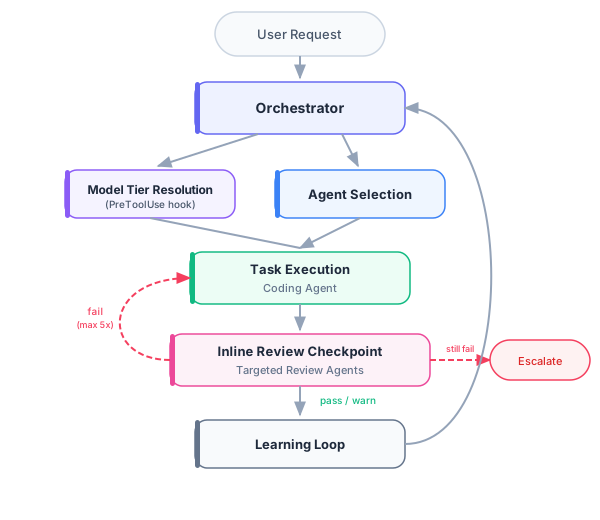
The Orchestrator receives every request, classifies it by type and complexity, selects agents, assigns models, and coordinates delivery. During Phase 3 (Implement), review agents check coding agent output at each discrete unit-of-work checkpoint. Findings feed back as structured corrections (max 2 cycles before human escalation). After each task, the learning loop captures metrics and evaluates whether configuration updates are needed.
Three-phase workflow
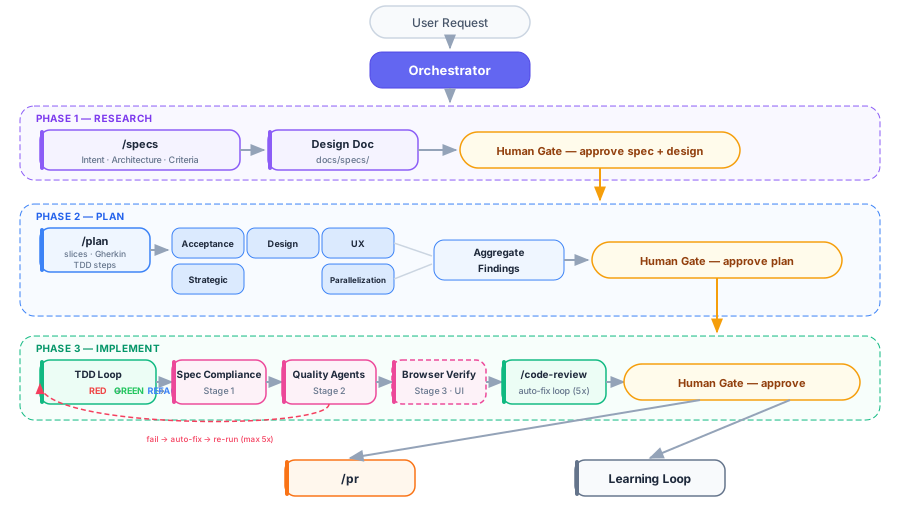
Feature work flows through three phases — Research → Plan → Implement — with a human gate between each. Research turns a request into approved specs (/specs produces Intent, Architecture, and Acceptance Criteria) plus a design doc; Plan decomposes them into vertical slices, authors each slice's Gherkin scenarios, and lays out the TDD steps, which up to five critic personas (Acceptance, Design, UX, Strategic, Parallelization — the set scales to plan tier) challenge before the human approves; Implement runs the RED-GREEN-REFACTOR build loop with a three-stage inline review (spec-compliance, quality agents, and browser verification for UI changes) and a /code-review gate, then opens the PR and feeds the learning loop.
Model Routing
Each agent declares an effort band (effort: low|medium|high) in its frontmatter. Band-to-model resolution is enforced by a PreToolUse hook (hooks/agent-model-resolve.sh, registered in settings.json under matcher: "Agent") backed by the resolver helper hooks/lib/model-resolve.sh: it reads the band by subagent_type and maps it via the shipped default map in knowledge/model-routing.json or, when present, a per-environment ladder .claude/model-ladder.json (gitignored, hand-written for restricted endpoints). The session model captured at SessionStart is the fallback for an unmappable model, never a ceiling. See agents/orchestrator.md → Resolution Procedure for the full algorithm, docs/model-routing.md for the contract and docs/model-routing-overrides.md for ladder authoring, and /model-routing-check for a read-only diagnostic.
Knowledge Index
knowledge/index.json is a deterministic, checked-in catalog of every H2/H3 section across knowledge/**.md and skills/**/SKILL.md. Each entry has a one-sentence summary and a slugified GitHub-style anchor. Agents that reference knowledge files cite an anchor (e.g. knowledge/owasp-detection.md#a03-injection) and read only the relevant section via offset/limit. Four freshness gates keep the index current: (1) PostToolUse hook auto-regen on save, (2) pre-commit sibling hook blocks stale commits, (3) tests/repo/knowledge_index_current.bats runs in CI, (4) tests/agents/agent_knowledge_anchor_tests.bats validates every reference resolves. See agents/orchestrator.md → Knowledge index — consumer usage pattern for the canonical lookup flow, and hooks/lib/build-knowledge-index.sh --check for ad-hoc verification.
Review-Fix Loop
Both inline review checkpoints (Phase 3) and /code-review use the same review-fix loop: targeted agents run in parallel, actionable issues (error/warning severity with high/medium confidence) are auto-fixed, and only the agents that reported issues are re-run against the modified files. The loop converges in up to 5 iterations or escalates to a human. /code-review is the final gate before commit.
For the full pipeline — targeting, pre-flight gates, static analysis pre-pass, ACCEPTED-RISKS suppression, fix-loop exit conditions, report generation, and the .review-passed gate file — see Code Review Process.
Test modernization workflow
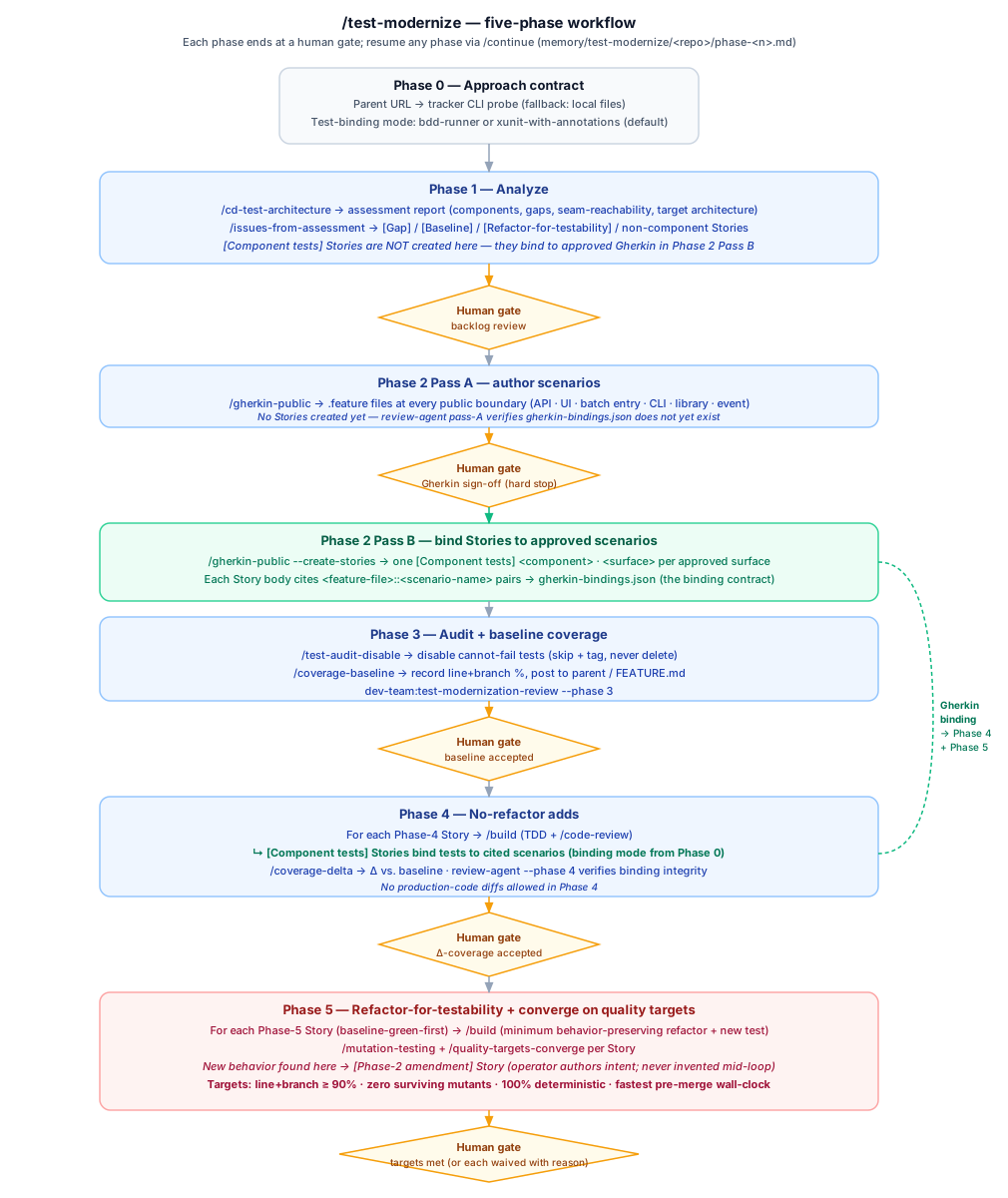
/test-modernize is a long-running orchestrator that sequences a five-phase remediation of a legacy repository's tests. Like /ship, it delegates each phase to the owning worker and stops at every human gate; unlike /ship, the deliverable is not a single PR but a tracker-managed backlog plus the gradual convergence of four quality targets: ≥ 90% line+branch coverage, zero surviving mutants, 100% determinism, and the fastest achievable pre-merge wall-clock with no off-machine dependencies (the airplane test).
The five phases:
- Analyze —
/cd-test-architectureproduces the assessment;/issues-from-assessmentconverts it into a parent + Phase-tagged child issues via the tracker CLI that matches the parent URL host (ghforgithub.com,az boardsfordev.azure.com,glabfor GitLab,aclifor*.atlassian.net). When no parent URL is given, or the matching CLI is not installed, the worker informs the operator and falls back to local plan files under./plans/test-modernize/. - Specify public interface —
/gherkin-publicruns in two passes around the human gate. Pass A writes.featurefiles at every public boundary (API endpoint, UI flow, batch-job entry point, CLI command, library export, event type) and stops. The human gate here is a hard stop — no Stories bind to un-reviewed scenarios. After the operator signs off, Pass B creates one[Component tests] <component> · <surface>Story per approved (component, surface), each Story body citing the specific<feature-file>::<scenario-name>pairs it must satisfy. The scenario → Story-id map (gherkin-bindings.json) becomes the binding contract Phases 4 + 5 consume. - Audit + baseline coverage —
/test-audit-disabledisables every test that cannot fail (skip + tag with reason; never deletes — Phase 4 repairs them);/coverage-baselinerecords line+branch percentages after the audit as the floor every later phase must improve on. - No-refactor adds — for each Phase-4 Story (in dependency order),
/builddrives RED-GREEN-REFACTOR with inline/code-review. For[Component tests]Stories,/buildbinds tests to the scenarios cited in the Story body using the binding mode chosen in Phase 0 (bdd-runnerorxunit-with-annotations); for[Baseline]Stories, tests lock in current behavior at existing seams (no Gherkin binding needed). After every Story closes,/coverage-deltaposts Δ vs. baseline AND runs scoped mutation testing on the Story's--story-files(production-code files derived from/build's commit diff — tests filtered; tracker CLIs not consulted), emitting a structured status (ok | net_new_survivors | first_measurement | tool_unavailable | skipped_empty_scope). Onnet_new_survivorsthe orchestrator pauses Story close with a halt prompt offering three operator actions ([s]strengthen,[f]drafts a Phase-5[Strengthen assertions]Story,[w]waive). At end-of-phase, an additional review loop dispatches/test-design+/code-reviewscoped to the phase diff and runs/apply-fixesfor up to 2 iterations before operator escalation; evidence is persisted tophase-4-review.json. Production code MUST NOT change in Phase 4. - Refactor-for-testability + converge — for each Phase-5 Story (predecessor: its
[Baseline]Story must be green first),/buildlands the minimum behavior-preserving refactor plus the test that needed the new seam. Phase-5[Component tests]Stories also bind to approved Scenarios./quality-targets-convergeruns after every Story; it reuses Phase-4'smutation-history.jsonfor files whose last commit pre-dates the recorded entry — only stale or absent files are measured fresh — then the loop picks the largest gap to the four targets and dispatches the smallest action to close it. When the action is "add a component test for a new behavior", the loop opens a[Phase-2 amendment]Story rather than inventing a Scenario — the operator remains the only author of intent. Same end-of-phase review loop fires (/test-design+/code-review+/apply-fixes, max 2 iterations) writingphase-5-review.jsonbefore the human gate. Targets are met or each remaining gap is explicitly waived with a recorded reason.
Between phases, dev-team:test-modernization-review reads the just-completed phase's deliverable from memory/test-modernize/<repo>/phase-<n>.md and either approves the advance or returns blocker findings. This agent is outside the standard review-dispatch fan-out — it gates process, not code. In Phases 2 and 4 it also verifies Gherkin binding integrity: every approved Scenario has a [Component tests] Story citing it, and every submitted test in those Stories cites the Scenario it exists to satisfy (drift in either direction is a blocker).
/continue resumes the workflow from any phase boundary by scanning memory/test-modernize/<repo>/phase-<n>.md; /test-modernize <repo> --from-phase <n> does the same explicitly.
For how /test-modernize composes with the rest of the test-evaluation tools, see Test Evaluation and Architecture.
Context Management
The Orchestrator manages context utilization using two operational skills.
Loading Protocol
Context Loading Protocol controls what gets loaded and when:
- Classify the task (simple, standard, multi-agent, complex)
- Select the minimum set of agents and skills required
- Load in phases: primary agent first, supporting agents as their phase begins
- Unload previous-phase agents via summarization before loading next-phase agents
Summarization
Context Summarization controls when to compress:
| Utilization | Action |
|---|---|
| < 40% | Normal operation |
| 40-50% | Prepare for summarization |
| 50-60% | Summarize older conversation turns |
| 60-75% | Aggressive summarization |
| 75%+ | Write summary to memory/, start new conversation |
Utilization is estimated via proxy signals (tool call volume, message count, accumulated file reads) as described in the Context Loading Protocol. Summaries follow a structured template and are stored in memory/ for cross-session continuity.
Token Budgets
| Component | ~Tokens |
|---|---|
| CLAUDE.md (always loaded) | ~800 |
| Single team agent | 290-560 |
| Single skill | 420-1,020 |
| All team agents (no skills) | ~3,590 |
| All review agents | ~3,100 (sub-agents, not loaded in parent context) |
| Knowledge files | ~3,450 (loaded on demand by agents) |
| Subagent prompt templates | ~1,800 (loaded by orchestrator when dispatching) |
| Full load (all team agents + all skills) | ~18,100 |
A typical task loads 1 agent + 1-2 skills: roughly 1,000-2,000 tokens of configuration overhead. Review agents and plan review personas run as isolated sub-agents — their context burden does not accumulate in the parent.
Plan Review Personas
Before the human reviews a plan (Phase 2), a tier-scaled set of critical review personas runs in parallel as sub-agents. The reviewer set scales to a plan tier (trivial/standard/complex, derived from slice count, file count, per-step complexity, and whether the plan takes a stance on any high-reversal-cost decision axis) so a one-function plan does not pay a complex feature's review ceremony: trivial runs the Acceptance Test Critic alone, standard adds the Design & Architecture Critic (plus the UX Critic for user-facing plans and the Parallelization Critic when the slice count > 1), and complex runs all five. The Acceptance Test Critic always runs; the Parallelization Critic runs only when slice count > 1. Each persona challenges the plan from a distinct perspective:
| Persona | Template | Effort | What It Challenges |
|---|---|---|---|
| Acceptance Test Critic | prompts/plan-review-acceptance.md |
medium | Per-slice Gherkin quality (determinism, isolation, completeness), criteria verifiability, error-path coverage, TDD step traceability |
| Design & Architecture Critic | prompts/plan-review-design.md |
medium | Dependency direction, abstraction quality, structural risks, pattern consistency |
| Parallelization Critic | prompts/plan-review-parallelization.md |
medium | Same-wave independence: file-overlap collisions (plan-waves.sh), disjoint-file behavioral coupling, residual cycles |
| Strategic Critic | prompts/plan-review-strategic.md |
medium | Problem-solution fit, scope assessment, risk analysis, opportunity cost |
| UX Critic | prompts/plan-review-ux.md |
medium | User journey, error experience, cognitive load, accessibility (self-skips for non-UI plans) |
Because these personas are prompt templates with no frontmatter, the PreToolUse model-resolve hook (which keys on subagent_type) cannot route them. /plan step 5b resolves the medium band to a model via hooks/lib/model-resolve.sh before dispatch and passes it as the model override, so the personas honor the same ladder and per-environment overrides as every registered agent rather than a hard-coded model.
Each reviewer returns a structured approve or needs-revision verdict. If any reviewer flags blockers, the plan is revised before the human sees it (max 2 iterations). Warnings from the dispatched reviewers are aggregated into a Plan Review Summary appended to the plan file, which also records the chosen tier and reviewer set so the scaling decision is auditable.
This gate catches problems when they cost minutes to fix (in a plan), not hours (in code).
Quality Assurance
Validation happens in this sequence during Phase 3:
| Order | Layer | Who | When |
|---|---|---|---|
| 1 | Self-validation | Active agent | Before delivering any unit of work |
| 2 | Inline review checkpoint | Targeted review agents | After each discrete unit of work |
| 3 | Review feedback correction | Coding agent | Up to 2 correction cycles per checkpoint |
| 4 | Final code review | /code-review |
Before committing; auto-scopes to uncommitted changes, runs full agent suite with fix loop |
| 5 | Documentation review | Tech-writer | After code review passes; verifies docs reflect current behavior |
| 6 | Peer validation | QA agent | After implementation, before phase delivery |
| 7 | Human gate | User | At each phase transition (Research, Plan, Implement) |
| 8 | Post-hoc monitoring | Orchestrator | During learning loop after task completion |
Every agent applies the Quality Gate Pipeline before output. This includes self-validation (Phase 1: factual accuracy, instruction fidelity, consistency, confidence scoring), verification evidence (Phase 2), and review-correction loops (Phase 3).
Quality gates by task type:
| Task Type | Required Gates |
|---|---|
| Code implementation | Self-validation + QA review |
| Architecture design | Self-validation + human approval |
| Documentation | Self-validation + terminology check |
| Bug fix | Self-validation + regression test |
| Data analysis | Self-validation + statistical validation |
Human Oversight
Agents operate autonomously within boundaries. The Human Oversight Protocol defines three levels of human involvement:
| Level | When | Example |
|---|---|---|
| Autonomous | Routine work within scope | Writing a unit test |
| Notify | Significant but within scope | Choosing between two valid patterns |
| Approve | High-impact or outside scope | Database schema change, production deploy |
Intervention commands (override, pause, stop) give humans immediate control when needed.
Governance
Governance & Compliance defines audit and ethics requirements:
- All task completions logged to
metrics/(JSONL format) - All configuration changes logged to
metrics/config-changelog.jsonl - Conversation summaries stored in
memory/for cross-session continuity - Significant routing and architectural decisions logged to
memory/decisions.md - Sensitive data (credentials, PII) never stored in metrics or memory files
- All agent decisions must be explainable on request
Pre-Execution Hook Pipeline
A PreToolUse hook (pre-tool-guard.sh) intercepts every Write and Edit call before execution:
| Action | Trigger | Behavior |
|---|---|---|
| Block | Path matches blocked_paths in guards.json |
Exit 2 — write cancelled, message shown |
| Warn | Path matches warn_paths in guards.json |
Exit 0 — write proceeds, warning shown |
| Allow | No match | Exit 0 — write proceeds silently |
Default blocked patterns: .env, *.pem, *.key, *.p12, *.pfx, *credential*, *secret*, *.token. Configurable via .claude/hooks/guards.json.
Destructive Command Guard
A second PreToolUse hook (hooks/destructive-guard.sh) monitors Bash tool calls for destructive commands: file deletion (rm -rf), database drops (DROP TABLE), git destruction (force-push, reset --hard), process killing, and permission escalation. Patterns are configurable via hooks/destructive-commands.json, which also includes a safe_allowlist for routine operations like rm -rf node_modules.
By default, destructive commands produce a warning (exit 0). When /careful mode is active, they are blocked (exit 2).
CodeGraph Nudge
A PreToolUse hook (hooks/codegraph-nudge.sh) registered on Read, Grep, and Glob recommends codegraph_* MCP tools over multi-file exploration when the project has a CodeGraph index (.codegraph/ in cwd). The hook is silent for single-file Read calls, for Grep with a regular-file path, for Glob with a literal pattern, and when a codegraph_* MCP tool has been used earlier in the current turn (tracked via a sentinel written by a companion PostToolUse hook on mcp__codegraph__.*). Warns to stderr by default; blocks (exit 2) under /careful. Fail-open posture throughout — any internal error exits 0. See docs/codegraph-nudge.md for the full mechanism.
Context Ceiling Guard
A PreToolUse hook (hooks/context-ceiling-guard.sh) registered on Agent and Skill enforces the 40% Context Window Rule. Before a capability-loading call it reads the real context occupancy from the transcript's most recent assistant-message usage (input_tokens + cache_read_input_tokens + cache_creation_input_tokens) and compares it to the model's context window. At or above the ceiling it warns to stderr (default, deduped by 5-point bucket per session) or blocks (exit 2) under DEV_TEAM_CONTEXT_STRICT=on. The occupancy is ground truth from the harness, not a model self-estimate — which is what makes the ceiling enforceable rather than advisory. Recovery skills (/context-summarization, /context-loading-protocol, /continue, /review-summary, /session-review) are never gated, so the path back under budget can't deadlock. The window resolves from DEV_TEAM_CONTEXT_WINDOW, else the 200000-token base window every current Claude model shares; the transcript omits the [1m] suffix, so a 1M-context model is indistinguishable here — set DEV_TEAM_CONTEXT_WINDOW=1000000 there. The ceiling percent is DEV_TEAM_CONTEXT_CEILING_PCT (default 40); DEV_TEAM_CONTEXT_CEILING=off disables. Fail-open throughout — any unmeasurable context or internal error exits 0.
Freeze Mode
The pre-tool-guard.sh hook also enforces freeze mode. When /freeze <glob> is invoked, it writes a state file (hooks/freeze-state.json) that restricts Write/Edit operations to files matching the allowed pattern. This prevents accidental edits outside the scope of a debugging session. /unfreeze removes the restriction. /guard <glob> activates both careful mode and freeze mode together.
Decision Log
Agents append to memory/decisions.md when making non-obvious decisions during task execution. The log persists across session resets, giving future phases visibility into prior reasoning without re-reading full conversation history.
Feedback Loop
Feedback & Learning enables continuous improvement:
- User provides feedback via keywords (
amend,learn,remember,forget) - Changes are previewed, applied, and logged with full audit trail
- The Orchestrator monitors for recurring patterns (3+ occurrences)
- System-initiated changes are proposed to the user with rationale
Performance Targets
Two metrics are instrumented today: token budgets (measured by scripts/measure-tokens.sh) and per-agent detection accuracy (measured by /agent-eval against evals/expected/*.json). Other goals — efficiency gains, hallucination rate, extraction accuracy, first-pass acceptance — are aspirational and have no sensor in this repo, so no numeric target is published until an instrument exists. See the Claims discipline section of CLAUDE.md for the full instrumented-vs-aspirational breakdown.