Top-level Workflows
Two slash commands in this plugin are orchestrator-only: they do not implement, review, or merge anything themselves — they sequence other skills and agents through their phases, holding the human gates between them.
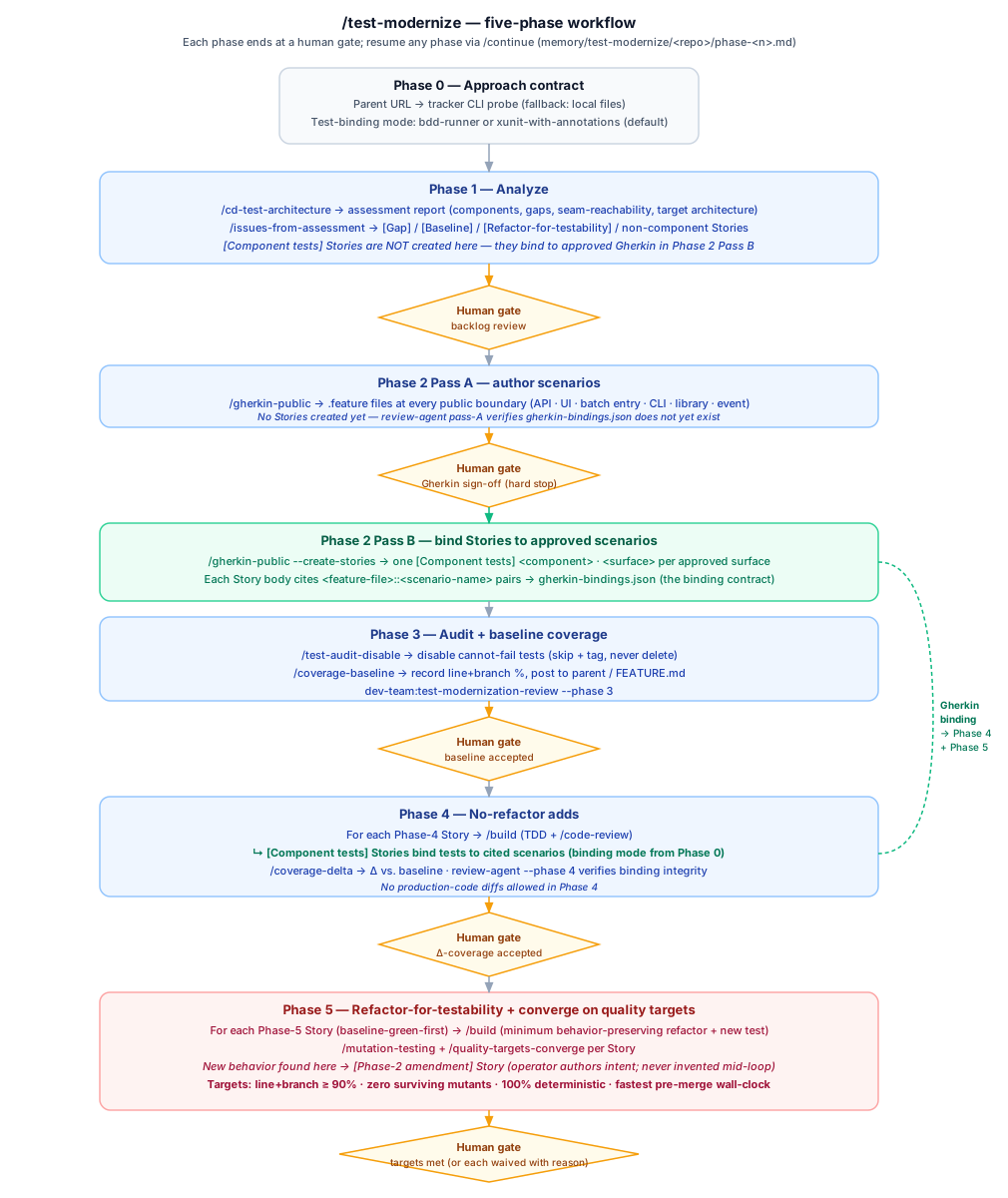
/ship— spec → plan → build → review → PR, end-to-end./test-modernize— five-phase legacy-test modernization for CD, from assessment to quality-target convergence.
Both follow the same orchestrator contract: delegate every phase to the owning skill or agent, honor human gates, surface ambiguous inputs in one batch up front, and report outcomes concisely.
/ship
File: skills/ship/SKILL.md
Role: orchestrator.
Use when: the user says "ship this", "take this feature end to end", or
wants the spec → plan → build → PR flow without re-assembling it each time.
Steps
| # | Step | Delegates to | Human gate after? |
|---|---|---|---|
| 1 | Approach contract — screen request against knowledge/decision-defaults.md; resolve ambiguous high-reversal-cost axes in one batch. |
(orchestrator only) | yes, if a blocker remains |
| 2 | Spec (skipped with --skip-spec) — produce Intent, Architecture, Acceptance Criteria. |
/specs |
yes — operator approves the spec |
| 3 | Plan — decompose into vertical slices with Gherkin scenarios; a tier-scaled set of plan-review personas (1–5, by plan complexity) runs in parallel before the gate. | /plan |
yes — operator approves the plan |
| 4 | Build — RED-GREEN-REFACTOR per slice, inline review checkpoints, verification evidence. Do not proceed until the suite is green. | /build |
no |
| 5 | Review — run quality-review agents and let the auto-fix loop converge. Only judgment-call findings escalate to the operator. | /code-review |
no |
| 6 | PR — pre-PR quality gate, open PR, arm auto-merge by default (--no-auto-merge to opt out). |
/pr |
yes — the PR is the final review artifact |
| 7 | Report — PR URL, quality-gate result, whether auto-merge is armed. | (orchestrator only) | — |
Agents involved (dispatched by the delegated skills)
/build's inline review checkpoints dispatch the review agents listed in
team-structure.md → Review Agent Dispatch.
/plan dispatches a tier-scaled subset of the five plan-review personas
(prompts/plan-review-*.md) — the Acceptance Test Critic always
runs; the rest are added as the plan's tier (trivial/standard/complex)
warrants — and the
progress-guardian gate-keeper.
/code-review re-runs the same review agents over the full changeset.
Arguments
/ship <feature-description> [--skip-spec] [--no-auto-merge]
Notes
- Sequencing only — every gate, fix loop, and evidence requirement comes from
the underlying skills. If any phase stops at a gate,
/shipstops with it. - For a plan-only pass, use
/plan; for build-only, use/build. - Resume across sessions with
/continue.
/test-modernize
File: skills/test-modernize/SKILL.md
Role: orchestrator.
Use when: a legacy repository needs its tests modernized for CD —
coverage ≥ 90%, zero surviving mutants, full determinism, fastest achievable
pre-merge wall-clock.
Each phase writes a progress file to memory/test-modernize/<repo-slug>/phase-<n>.md
so /continue and --from-phase <n> can resume.
Phases
0. Approach contract
Orchestrator only. Resolve <repo-path>, the parent issue URL (and the
tracker CLI it maps to: gh / az boards / glab / acli, or local-files
mode when empty), CI config, external test sources, quality targets, and the
test-binding mode for the approved Gherkin (bdd-runner or
xunit-with-annotations). Record the choices in
memory/test-modernize/<slug>/phase-0.md.
1. Analyze
Assess the repo against CD test-architecture criteria and emit phase issues.
| Step | Delegates to |
|---|---|
| 1.1 Assessment | /cd-test-architecture |
| 1.2 Parent + Phase-1/2/5 child issues | /issues-from-assessment |
| 1.3 Phase gate review | Agent dev-team:test-modernization-review with --phase 1 |
Human gate — approval before specifying the public interface.
2. Specify public interface (two-pass)
Two-pass design so Stories never bind to un-reviewed scenarios.
| Step | Delegates to |
|---|---|
2.A Author .feature files for every public surface (API endpoint, UI flow, batch-job entry point, library export, event type) |
/gherkin-public |
| 2.A.2 Phase gate review | Agent dev-team:test-modernization-review with --phase 2 |
Human gate — operator validates the Gherkin (hard stop; .feature files may be edited in place) |
|
2.B --create-stories — one [Component tests] <component> · <surface> Story per approved surface, scenario→Story map written to gherkin-bindings.json; backfill Phase-1 placeholders |
/gherkin-public |
3. Audit + baseline coverage
| Step | Delegates to |
|---|---|
| 3.1 Disable cannot-fail tests (skip + tag, never delete) | /test-audit-disable |
3.2 Capture baseline coverage and post to parent issue / FEATURE.md |
/coverage-baseline |
| 3.3 Phase gate review | Agent dev-team:test-modernization-review with --phase 3 |
Human gate — baseline accepted before adding tests.
4. Fix disabled tests + add no-refactor tests
For each Phase-4 child issue in dependency order:
| Step | Delegates to |
|---|---|
4.1 Drive RED-GREEN-REFACTOR per Story. [Component tests] Stories bind tests to the cited <feature-file>::<scenario-name> pairs using the Phase-0 binding mode; [Baseline] Stories lock in current behavior at existing seams. |
/build |
4.2 After each Story closes, post Δ vs. baseline AND run scoped mutation against the Story's --story-files (production-code files from /build's commit diff; tests filtered) |
/coverage-delta --story <id> --story-files <files> |
4.2b On status: net_new_survivors, surface halt prompt with three operator actions ([s] strengthen / [f] follow-up — drafts Phase-5 [Strengthen assertions] Story / [w] waive). On status: tool_unavailable, triage with [i] install via /init-dev-team / [k] skip — proceed advisory / [q] quit. |
(orchestrator — owns the halt; worker exit code is always 0) |
| 4.3 After all Phase-4 Stories close, verify scenario→Story-id map against submitted test code | Agent dev-team:test-modernization-review with --phase 4 |
4.4 End-of-phase test review: dispatch /test-design --since <phase-4-base-sha> AND /code-review --since <phase-4-base-sha>. On error/warning findings, dispatch /apply-fixes; re-run /code-review; loop max 2 iterations before escalating with [r]/[w]/[q]. Evidence persisted to phase-4-review.json. |
/test-design + /code-review + /apply-fixes |
Human gate — Δ-coverage AND Phase-4 mutation results AND phase-4-review.json (any waivers explicit) accepted before any production-code refactor.
5. Refactor-for-testability + converge
For each Phase-5 child issue in dependency order:
| Step | Delegates to |
|---|---|
5.1 Confirm matching [Baseline] Story is closed and green (precondition) |
(orchestrator only) |
| 5.2 Minimum behavior-preserving refactor + the test the new seam unblocks | /build |
5.3 Loop until coverage / mutants / determinism / pre-merge wall-clock targets are met (or explicitly waived with reason recorded). Reads mutation-history.json (written by Phase 4) and reuses per-file survivor counts when the file's last commit pre-dates the history entry — re-measures only the gaps. |
/quality-targets-converge |
| 5.4 Phase gate review | Agent dev-team:test-modernization-review with --phase 5 |
5.5 End-of-phase test review: same loop as 4.4, scoped to <phase-5-base-sha>. Evidence persisted to phase-5-review.json. |
/test-design + /code-review + /apply-fixes |
Human gate — final metrics AND phase-5-review.json accepted (or each gap waived with reason).
6. Report
Final coverage %, surviving mutants, determinism status, pre-merge wall-clock,
the parent issue URL (or ./plans/test-modernize/FEATURE.md), the list of
PRs /build opened in Phases 4 and 5, and any waived targets with reasons.
Agents involved
dev-team:test-modernization-review— phase gate-keeper. Reads each phase deliverable frommemory/test-modernize/<repo>/phase-<n>.mdand verifies it matches the phase's acceptance criteria before the workflow advances. Process gate-keeper, not a code reviewer — not in the standard review-dispatch fan-out.- The review agents dispatched by
/build's inline checkpoints (same set/shipuses) — seeteam-structure.md→ Review Agent Dispatch.
Arguments
/test-modernize <repo-path> [--parent <issue-url>] [--ci <path>] [--external-tests <loc>] [--from-phase <n>]
Notes
- Sequencing only — every gate, fix loop, and evidence requirement comes from the underlying skills.
- For Phase-1-only analysis without committing to the full workflow, invoke
/cd-test-architecturedirectly. - The workflow is identical whether or not a tracker CLI is installed — only
the destination of the issues changes (tracker vs.
./plans/test-modernize/). - The operator-facing diagram lives at
diagrams/test-modernize-flow.svgand is embedded inagent-architecture.md.
Why these are documented together
/ship and /test-modernize are the only two multi-phase pipelines with
inter-phase human gates in the plugin. Every other slash command is either
a single-step worker (e.g. /coverage-baseline, /triage) or a one-shot
orchestrator that returns in a single pass (e.g. /code-review,
/test-design). Knowing the phase order, the owning skill or agent for each
step, and where the human gates fall is the difference between operating
these workflows confidently and re-reading every SKILL.md each time.